Es mostren els missatges amb l'etiqueta de comentaris contenidos. Mostrar tots els missatges

dimarts, 7 de febrer del 2012

Libros infantiles para Ipad. Nuevas formas de editar

Libros infantiles para Ipad. Nuevas formas de editar

The Fantastic Flying Books of Mr. Morris Lessmore iPad App -


y otros interesantes:

5 Cuentos Infantiles Clásicos se Reinventan para iPad 


Santillana lanza aplicaciones infantiles para iPad y iPhone : Los personajes de 'Mica y sus amigos' y "El baúl encantado' protagonizan aventuras orientadas al desarrollo cognitivo de los niños

dimarts, 22 de novembre del 2011

presentaciones sin powerpoint. otra manera de aplicar la tecnología
Watch live streaming video from agoradirecto at livestream.com

dilluns, 12 de setembre del 2011

Los lunes... periodismo y social media (II)


SEO, el contenido ¿sigue siendo el rey?


Suggestions (but not standards) for live tweeting « The Buttry Diary: "Suggestions (but not standards) for live tweeting"


The LA Times on the role of its SEO chief – ‘the key is feedback’ | Editors' Blog | Journalism.co.uk: "The LA Times on the role of its SEO chief – ‘the key is feedback’"


BostonGlobe.Com Launches Today; Shifts To Paying Subscribers Only Oct. 1

One of the most unusual efforts to make money from a newspaper web site launches today in Boston


The news entrepreneur's dilemma: Which comes first, the money or the audience?


For years, programmers have experimented with software that takes data, like that from sports statistics, company financial reports and housing starts and sales, and turns it into articles. Most of these efforts had a formulaic, fill-in-the-blank style. They read as if a machine wrote them. But the articles produced by Narrative Science are different.http://www.ticbeat.com/tecnologias/seo-contenido-sigue-siendo-rey/

dilluns, 5 de setembre del 2011

Los lunes... periodismo y social media


By now, plenty of people have written about the need for traditional media entities to embrace social media as a way to engage with their readers, or what journalism professor Jay Rosen has called“the people formerly known as the audience.” We’ve even written about it ourselves on a number of occasions, andhow important it is for newspapers and other outlets to do this. But few have put the argument as well as a student journalist did in a recent column for The Daily Californian, the student newspaper at the University of California at Berkeley. The bottom line, Mihir Zaveri says, is that the media itself is to blame for most of its problems, because it has failed to maintain the trust of its readers — and engaging with those readers in as many ways as possible is one of the only ways to try and reverse that state of affairs (...).


MediaShift Idea Lab . Journalists Should Join Google+ to Understand What Comes Next | PBS: "Journalists Should Join Google+ to Understand What Comes Next"


This month's Carnival of Journalism, a site that I've organized where bloggers can convene to all write about the same topic, was hosted by Kathy Gill, a social media consultant and senior lecturer at the University of Washington, who seized on the new social network that is Google+.
Still in its infancy, Google+ has been the topic of many-a-tech blog posts. As a former tech writer, I love and hate this stuff. Sometimes I want to slap Mashable right in the "http" and tell them to never do another "Top X Ways [name your industry professionals] Can Use [new social-networking tool]." If you are curious though, here are the top five ways journalists can use Google+, courtesy of Mashable.
google.png
Equally, I want to avoid speculation about Google+ vs. Facebook or Twitter, etc. It's a valid conversation, but there is already plenty of it. If a Facebook executive has a sneeze that sounds like "aww-choogle-phluss," the tech press is all over it. I personally am not a fan of Facebook and welcome my Google+ overlords. I do have a post in me about privacy, Silicon Valley speculation, etc. -- but I don't want to add my voice to that already loud chorus.

Instead, I want to write about Google+ in terms of everyday average use -- both how journalists use the Internet and how everyday average people use the Internet (assuming the latter is slightly different) .......

.


The Top 10 Ways Journalists Use the Internet - 10,000 Words: "The Top 10 Ways Journalists Use the Internet"


According to a new survey, one of theleast popular ways journalists use the Internet is to create podcasts. But what is the top use? Is it to lurk on Facebook or Twitter? Or is it to constantly go on Google and search for story ideas? What do the majority of journalists use the Internet for?
The 2011 Arketi Web Watch Media Survey, sponsored by the PR firm Arketi Group, says the majority of its respondents use the Internet to read news.(...)

dilluns, 25 de juliol del 2011

El portal Enfermera virtual integra un centenar de fichas de Vademecum sobre fármacos


Esta integración es posible gracias a un acuerdo que el Col•legi Oficial d’Infermeres i Infermers de Barcelona (COIB) firmó hace un año con Vademecum con el objetivo de que ambas organizaciones compartan información y conocimientos en salud y farmacología.
Enfermera virtual (www.infermeravirtual.com), el portal de educación y promoción para la salud del Col•legi Oficial d’Infermeres i Infermers de Barcelona (COIB), integra actualmente un centenar de enlaces directos a fichas técnicas de fármacos publicadas en Vademecum.
Así, la enfermera que consulte Enfermera virtual tiene a su alcance un web de conocimiento integrado, ya que desde un mismo portal dispone de todos los recursos necesarios para proporcionar los mejores cuidados enfermeros y ayudar al usuario a tomar decisiones que le ayuden a mejorar su salud.
Por ejemplo, desde la ficha de la actividad de la vida diaria de respirar, se incluyen enlaces hacia Vademecum sobre tratamientos farmacológicos que pueden afectar al centro respiratorio, estimulando o deprimiéndolo, como la morfina, el diazepam, el lorazepam o la teofilina.
En el caso de los contenidos de tabaquismo de Enfermera virtual se incorporan enlaces hacia fichas técnicas relacionadas con tratamientos para dejar de fumar como los parches y los chicles de nicotina, el bupropión o la varenicilina.
De momento, desde Enfermera virtual se pueden consultar fichas técnicas de fármacos, que se encuentran en Vademecum, a través de los contenidos relacionados con respirar, tabaquismo, comer y beber, antidiabéticos orales y enfermedad inflamatoria intestinal, entre otras.
Por otra parte, desde la página de Vademecum se puede encontrar información de consejos de salud, procedentes de Enfermera virtual. Así, desde las fichas técnicas de fármacos y de enfermedades y síntomas de Vademecum se han incorporado más de 1.480 enlaces de consejos de salud de Enfermera virtual.
Convenio de colaboración
Este intercambio e integración de contenidos es posible gracias a un acuerdo de colaboración que el Col•legi Oficial d’Infermeres i Infermers de Barcelona (COIB) firmó hace un año con Vademecum con el objetivo de que ambas organizaciones compartan información y conocimientos en salud y farmacología.
El objetivo del COIB y de Vademecum es seguir ampliando la cantidad de información para compartir. Así, en el futuro está previsto incluir en los contenidos de Enfermera virtual, además de enlaces a fichas farmacológicas de Vademecum, enlaces a fichas de productos y material sanitario que utilizan las enfermeras para sus cuidados.
El portal Enfermera virtual ha duplicado en el último año el número de visitas, al pasar de 33.100 a 67.029 visitas mensuales. La mayoría de los navegantes que entra a Enfermera virtual (83,94%) lo hace mediante buscadores, mientras que un 11,77% lo hace accediendo directamente al web.
El acceso mediante la página corporativa del COIB, de Vademecum y de redes sociales son los siguientes puntos de inicio que utilizan los usuarios para acceder a Enfermera virtual. El 87% de los usuarios de Enfermera virtual son personas que entran por primera vez a este portal.

dilluns, 18 de juliol del 2011

ECREA JSS Pamplona 2011 | XXVI CICOM: Diversity of Journalisms conference

ECREA JSS Pamplona 2011 | XXVI CICOM: Diversity of Journalisms conference


Proceedings of the ECREA/CICOM Conference

Journalism is undergoing times of change. Since the impact of digital technologies in media markets around the mid 1990’s, this profession has experienced fast and often sudden transformations.
This process has brought an increasing complexity to journalism exercise. In the middle of a pre-existing media scene of newspapers, radio, television and agencies, a new digital medium arises, mainly represented by the Web and mobile platforms. Media companies have also undergone a deep reconfiguration, marked by the redefinition of their traditional business models. Journalists, the main figures of the information activity, have witnessed how their profession has evolved in a context of a brisk replacement of technologies and a new and more interactive relation with the audiences. Finally, the news content has also experienced its own particular process of transformation, with the arrival of new multimedia languages.
Briefly, in just a few years, the media landscape has been entirely reconfigured. And, even though the process is far from being completed, it is certainly noticeable the emergence of a new journalism with new professional profiles, where the distinctive feature is, mainly, diversity.
In view of this new scenario, it is quite urgent to reconsider the academic research on journalism. In order to deal with the growing complexity of media, new approaches and specific methodologies become necessary. Furthermore, it would be definitely essential to do so from an international perspective, thus different research experiences could enrich one another.
These Proceedings gather the research works presented to the Conference “Diversity of Journalisms: Shaping Complex Media Landscapes”, held in Pamplona (Spain), the 4th and 5th of July, 2011. This event was co-organised by ECREA Journalism Studies Section and the School of Communication of the University of Navarra. In the case of ECREA Journalism Studies Section, one of the thematic units of the European Communication Research and Education Association, this was its second conference, after that one held in Winterthur (Switzerland), 2009. As for the School of Communication of the University of Navarra, this convention was the 26th edition of its International Conference of Communication (CICOM), the most veteran academic congress in the field of communication among all those hosted in a Spanish speaking country.
The Conference had a successful response. There were 133 papers proposals, from nearly 30 different countries from all five continents. Due to organisational purposes and inspired by the idea of reaching a high quality level of academic contributions, the number of papers accepted for presentations during the Conference was limited to 80. This selection was made by 30 international reviewers, with a recognized experience as researchers in the field of journalism and communication.
This volume is structured in three main parts: ‘Papers’, ‘Abstracts’ and a final ‘List of authors’.
The first part gathers 28 full text papers, submitted by authors to the Conference organisation before the deadline established for reception of full original texts. Papers are arranged alphabetically according to the last name of first author.
The Abstracts section is a compilation of the 80 paper proposals that had a positive evaluation by the international reviewers which collaborated in the selection process. Papers are sorted in alphabetical order according to last name of first author.
Finally, there is a list of contributors, which mentions all authors that submitted a paper, either individually or collectively, together with their academic filiations and the panel where the paper was scheduled to be presented. The reader will notice how in certain cases, the papers’ mentions are followed by the observation ‘resigned’; this note indicates that, days before the Conference, the author of such paper informed the organisation about his/her intention of not attending the event. Due to the particular difficulties of the editing process of these Proceedings, which have been published days before the Conference, it was impossible to remove those works that were finally non-presented.
On behalf of the Management Team of ECREA Journalism Studies section, I wish to thank, first of all, the School of Communication of the University of Navarra, for its valuable support to the organisation of this international event. We are also very grateful for the collaboration of ECREA which, through its academic networks, made possible the diffusion of the call for proposals for this event and favoured its significant international response. We would also like to give recognition to the generous and disinterested participation of the keynote speakers of the different plenary panels: Aidan White, journalist and former General Secretary of the International Federation of Journalists (1987-2011); professor Maxwell McCombs, Jesse H. Jones Chair in Communications (University of Texas at Austin, USA); Howard Tumber, editor of Journalism. Theory, Practice and Criticism (SAGE Publications); Concha Edo, editor of Text&Visual Media (Spanish Journalistic Society - SEP); Larry Gross, editor of the International Journal of Communication and president of the International Communication Association (ICA) in 2011-2012 (University of Southern California); and Ana Azurmendi, editor of Comunicación y Sociedad (School of Communication, University of Navarra).
Lastly, we would also like to express our thanks to two public institutions: the Spanish Ministry of Science and Innovation, which sponsored the Conference through the research project “Evolución de los cibermedios en el marco de la convergencia. Multiplataforma e integración periodística” [The Development of Spanish Cybermedia in the Convergence Context: Multiplatforms and Journalistic Integration] (ref.: CSO2009-13713-C05-03); and the Pamplona City Council, for the reception which was offered to the participants.
Ramón Salaverría, PhD
Chair of the ECREA Journalism Studies Section

Diversity of Journalisms. Proceedings of the ECREA Journalism Studies Section and 26th International Co

nota de prensa El 85% de los usuarios de guías de viaje están dispuestos a pasarse al móvil.


NOTICIAS
12/07/2011

Encuesta sobre consumo de contenidos de ocio

Esta investigación se realizó con el fin de identificar nuevos comportamientos en el consumo de contenidos de ocio.

El 85% de los usuarios de guías de viaje están dispuestos a pasarse al móvil.
Casi todos los encuestados (95%) están dispuestos a emigrar a guías de viajes con formatos orientados a las nuevas tecnologías.
Esta investigación se realizó con el fin de identificar nuevos comportamientos en el consumo de contenidos de ocio. El fin era conocer los medios más empleados por los usuarios en la búsqueda de información sobre destinos, sus exigencias y preferencias entre los diferentes canales existentes.
Actualmente el mundo de los viajes está sufriendo cambios importantes y uno de los aspectos más relevantes es el hecho de que, desde hace unos años, los consumidores están tomando el control de la planificación de sus viajes, cambiando con esto el proceso de búsqueda de información.
Resulta curioso que sólo el 50% de los encuestados utilice guías de viaje, de las cuales más de la mitad son en formato no digitales, ya que según esta encuesta, el 73,2% no ha utilizado nunca una guía para aplicativos móviles. Sin embargo, independientemente de que más de la mitad de las guías usadas por estos cibernautas son en formato papel, sus preferencias están orientadas de la siguiente manera: un 40,5% las prefiere en papel, un 30,4% opta por el libro electrónico y un 27,5% apuesta por las app móviles. Esto pone de manifiesto que las nuevas tecnologías están penetrando en la mente de los consumidores.
Aunque el 73,2% de los encuestados nunca ha utilizado guías de viaje para dispositivos móviles, el 84,5%de estos encuestados está interesado y dispuesto a usarlas, siempre y cuando éstas cumplan con las siguientes características:
  • Ser accesibles en la mayoría de los modelos de móviles
  • Tener contenidos actualizados y de calidad
  • Ser fáciles de manejar y pensadas para usuarios en movilidad
  • Poder personalizar los contenidos
  • Acceder a ellas desde cualquier lugar y plataforma
  • Poder compartir experiencias con amigos

Esta encuesta fue realizada por Alhena Media durante el mes de mayo de 2011 entre una muestra de unos 500 cibernautas, de un rango de edad entre 18 y 55 años, originarios de España y Latinoamérica, y una pequeña proporción pertenecientes a China y otros países de Europa. Estas personas son de clase media y media alta y, en su mayoría, profesionales de diversas áreas relacionadas con el turismo.
Es inevitable suponer que las generaciones, actuales y venideras, de consumidores están dispuestas a consumir información valiosa para sus viajes, por lo que esta información ha de estar accesible en todo momento, en el formato idóneo para cada micro segmento.
Alhena Media es una empresa especializada en contenidos de ocio y viajes en diferentes canales. Actualmente, Alhena Media cuenta con tres colecciones de guías de viajes, cada una orientada a las necesidades y exigencias de distintos tipos de viajeros: Bradt, orientada a verdaderos viajeros independientes y aventureros, altamente motivados a practicar un turismo responsable en cada uno de sus viajes; Gente Viajera, dirigida a escapas de corta duración; Alhena Literaria, un acercamiento a los relatos de viajes de los clásicos, de autores consagrados y, además, una apuesta por descubrir nuevos viajeros, nuevos creadores.


dimecres, 13 de juliol del 2011

Ya puedes ver los Workshops celebrados durante la Gala Aspid

Ya puedes ver los Workshops celebrados durante la Gala Aspid

01 Jul. 2011
Ya puedes ver los Workshops celebrados durante la Gala Aspid

Ya es posible visualizar los workshops celebrados el pasado 14 de junio de 2011 durante la Gala de entrega de la XV Edición de los Premios Aspid de Publicidad Iberoamericana de Salud y Farmacia en Barcelona.
Los podéis ver clickando aquí.
* Vídeo 1: Jordi Negre. Dantex Group. ' Web 3D. Como optimizar el retorno de las inversiones en marketing mediante el uso de entornos en tres dimensiones'.
* Vídeo 2: Cristina Garrote. Brick Comunicación. 'Creatividad healthcare en entorno online: ¿qué nos dejan hacer?'.
* Vídeo 3: Paul Bonnet. Vademecum. 'Nuevas posibilidades de comunicación en la industria farmacéutica'.
* Vídeo 4: Julio González. Global Healthcare. 'La fórmula del éxito en marketing online para pacientes y profesionales'.
* Vídeo 5: Santiago Culí. Boehringer Ingelheim. 'Cómo conseguir que nuestra campaña sea noticia'.

dimecres, 6 de juliol del 2011

10 ways reporters can use LinkedIn to find sources, track changes at companies | Poynter.


10 ways reporters can use LinkedIn to find sources, track changes at companies

The business networking site LinkedIn is more than just a place to find your next job. It’s a powerful and often underused resource for finding news sources and story ideas.
LinkedIn now has more than 100 million members and is gaining more than than one new member every second, said Krista Canfield, LinkedIn’s senior manager of corporate communications and an evangelist to working journalists.
Reporters can find sources and leads through status updates, employee transitions and data that LinkedIn aggregates and analyzes. “There’s a wide variety of different types of professionals that are on the site. which makes it a wonderful resource for journalists,” Canfield said.
Between my own use of LinkedIn and Canfield’s advice, I’ve identified 10 key ways a journalist can do better reporting by using LinkedIn.

Search status updates

One reporting tool is the “signal” search. It enables you to search all the public status updates posted by LinkedIn members. While some are posted directly to LinkedIn, many are imported from users’ Twitter accounts. That makes this tool a proxy to filter Twitter by company, job title or other business roles in ways Twitter’s own search tool cannot.
Reporters could use this in at least two ways.
See what a company’s employees are saying. Filter your signal search by a specific employer to see what the staff is talking about. This could be especially useful if the company has made news that employees may be reacting to. Or you could see what employees of a competing company are saying about another company’s product launch.
(For instance, to see what Google employees are saying about Google, search for the keyword “Google.” When the initial results come up, filter them by selecting the “3rd + Everyone” box under “Network” and typing “Google” or choosing it from the choices in the “Company” section.)
See what people in your town are saying. Localize a national business story by filtering your signal search by location.

Do targeted searches for individuals or types of employees

LinkedIn can also be used to find experts and other sources on short notice. Using the advanced people search, you can sort through all the service’s members.
LinkedIn’s advanced people search has many fields to search by.
Find a specific person. Search for someone’s name to find out where she works. Search for a job title and a company to find out who holds that position. Or search for a person and a company to find out his job title. You can use any combination of names, job titles, companies, keywords, locations and more to find the person you’re looking for.
Find all employees of a company. Search the company name and see all the results. Contact the people who are relevant to your reporting.
Find former employees. People who used to work for a company may be more willing to talk to reporters than current employees. LinkedIn makes it easy to find former employees. Search for a company name, then select the “past, not current” employment option beneath.
Be alerted when employees leave or join. With a paid LinkedIn account (starting at about $20 a month), you can save a search and receive email updates on any changes. Save your search for current or former employees of a company and LinkedIn will notify you whenever there’s a change.
Find experts to interview. Do an advanced search by job title to find qualified experts. Or use the new skills search to find people who list certain skills on their profile. This can be a huge help in finding qualified sources on niche topics. (Here are some top experts in educational psychology, for example.)

Keep on top of changes within companies

You can use LinkedIn’s company pages to stay up-to-date on companies on your beat. Company pages aggregate information from all LinkedIn members who are employees of a particular firm.
Track hiring trends. The company page shows job postings. You might learn about a new strategic initiative by seeing what types of jobs the company is adding.
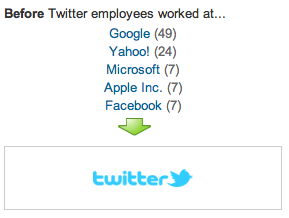
LinkedIn’s company statistics page for Twitter shows its employees are most likely to have come from Google or Yahoo.
Get quick company backgrounds. On any company page, click the link on the right side that says “Check out insightful statistics…” Here you’ll see breakdowns of the job functions, years of experience, and educational backgrounds of employees, all with comparisons to industry averages. This can help you understand a company you haven’t dealt with before.
See where employees tend to come from, and leave to. On the right side of that same company statistics page, you’ll see lists of the most common companies that current employees came from, and the employers they leave for most often. You may find a trend story about who is poaching a company’s employees.
If you’ve found this useful, you can learn more and keep up with the latest changes on LinkedIn in a few ways. Follow the official blog and press center, test out beta features on LinkedIn Labs, or join the LinkedIn for Journalistsgroup for more tips and advice.