Web2.0 y Salud: Redes sociales y Hospitales: "Redes sociales y Hospitales
La Web 2.0, incluidas las redes sociales, está revolucionando la comunicación entre hospitales, médicos y pacientes. Cada vez más, los hospitales utilizan las redes sociales como herramientas que sirven para mantener el contacto con los enfermos, incluso cuando salen del hospital, y para atraer nuevos pacientes (hospitales privados). Para eso es necesario conseguir la participación de los pacientes compartiendo sus experiencias y superación de obstáculos en el tratamiento de su enfermedad (Facebook, YouTube); presentar entrevistas con especialistas sobre avances científicos que haya descubierto el equipo profesional o información sobre enfermedades en que son punteros, p.ej. Degeneración macular asociada a la edad (YouTube, Slideshare); responder a preguntas sobre enfermedades o problemas específicos en Twitter, de forma muy abreviada y enlazando con mas información; resaltar eventos que sirven para profundizar en temas , p.ej. Día Mundial del Autismo, Día mundial del Parkinson (Facebook, "
[...]
Aunque en el uso de las redes sociales estamos a un nivel similar al de los países más avanzados –España sólo presenta un punto porcentual por debajo de países como Estados Unidos- el uso de redes sociales (Facebook, Twitter, etc.) por parte de los hospitales es bajísimo. Según el Obsevatorio permanente de las TIC en Salud (http://www.observatics.com/), sólo 83 de 788 hospitales españoles utilizan alguna red social, lo que supone apenas el 10,5% del total, además solo 388 cuentan con web propia (30/03/2012).
Texto completo en http://fecoainesta.blogspot.com.es/2012/04/redes-sociales-y-hospitales.html
Es mostren els missatges amb l'etiqueta de comentaris comunidades y redes sociales. Mostrar tots els missatges
Es mostren els missatges amb l'etiqueta de comentaris comunidades y redes sociales. Mostrar tots els missatges
dimarts, 17 d’abril del 2012
dimarts, 10 d’abril del 2012

dijous, 19 de gener del 2012
La clínica Mayo explica las redes sociales
2012 Webinar Series Kicks Off Tomorrow
The Mayo Clinic Center for Social Media begins our 2012 webinar series, produced in conjunction with Ragan Communications, on Thursday, Jan. 19 with a presentation by a physician on how hospital communicators can make the case for their physicians to become involved in social media.
 The webinar, “Communicators: Convince your hospital’s docs to dive into social media,” features Dr. Natasha Burgert, a board certified pediatrician from Kansas City who sees patient families full-time and also serves as the social media community manager for her private practice group. She often discusses parenting and child health on her blog, KCKidsDoc.com.
In this webinar, which runs from 2-3:15 p.m. CST on Jan. 19, Dr. Burgert will explain her journey from distant social media observer to community manager and medical blogger and will describe how joining online communities has benefited her medical practice and transformed how she connects with patients.
During this webinar, you will learn:
- How patients use the Internet for health care
- What patients really look for when they go online
- How most large health care organizations miss their social media targets
- How a physician should measure social media ROI
- How to define and overcome barriers to doctors’ use of social media.
- How to find the most effective tools for your online community audiences
- A simple formula to make your online content relevant and engaging
- Pitfalls and practical first steps as you investigate social media for your staff doctors.
The webinar registration is free for members of Mayo Clinic’s Social Media Health Network, who can click here to access the free registration link via the Network community site. For more information about the Social Media Health Network, see the list of members and how to join.
Non-members can register on the Ragan store.


dilluns, 12 de desembre del 2011
Las campañas de Salud en Tuenti triunfan entre los jóvenes
prsalud
| Las campañas de Salud en Tuenti triunfan entre los jóvenes |
| GONZALO FERNÁNDEZ | 06/12/11 10:11 |
La Red Social por excelencia entre los jóvenes españoles también comienza a ser punto de encuentro entre pacientes y foro de consultas sobre temas sanitarios. Diabetes, alzheimer, sexo o drogas son los problemas relacionados con la Salud que más preocupan. Sin embargo, desde Tuenti aseguran que aún es una Red Social por explotar en lo que a campañas de sensibilización sobre hábitos saludables se refiere.
 |
dilluns, 12 de setembre del 2011
Nota de Prensa: Sigue toda la actualidad de Eureka by Merial en las redes sociales
El programa refuerza su propuesta de valor a través de una cuidada estrategia on-line.
Una de las plataformas líderes en servicios a la comunidad veterinaria, Eureka by Merial, ha puesto en marcha su nueva estrategia global de comunicación en Internet y redes sociales. El objetivo es ampliar los canales de comunicación hacia el usuario, con la finalidad de que los servicios, informaciones y novedades del programa se divulguen en tiempo real.
Y esta vez amplifica su radio de comunicación, además de la web, cuenta con sus nuevos canales de comunicación en facebook, twitter, linkedin y youtube. Nuevos canales donde los usuarios encontrarán contenido y artículos relacionados con cada uno de los proyectos que forman Eureka by Merial.
Eureka by Merial sigue apostando por encaminar sus servicios hacia el desarrollo de una filosofía de trabajo basada en la diferenciación, con la finalidad de aportar soluciones a las necesidades reales en los diferentes ámbitos de la empresa, gestión, calidad, RR.HH., comunicación, marketing, formación, coaching, finanzas, apoyo al diagnóstico y servicio del cliente.
Así, Eureka by Merial se convierte, definitivamente, en un universo de excelencia donde se promueve la medicina preventiva, la fidelización de los pacientes y la sinergia entre todos los actores de la clínica veterinaria.
dijous, 1 de setembre del 2011


Hermes Cloud. Gestión del conocimiento biomédico en la nube
Iniciativa del Clinico San Carlos de Madrid
Bienvenido
'via Blog this'
Bienvenido
Nos complace darte la bienvenida a una nueva forma de comunicación profesional: la Comunidad HERMES del Hospital Clínico San Carlos.
El hospital San Carlos es un centro puntero en el panorama sanitario nacional, con una mentalidad innovadora, asistencial, docente e investigadora.
La Comunidad en la estás a punto de ingresar te permitirá comunicarte, tanto a nivel personal como colectivo, con los profesionales sanitarios de tu hospital; establecer grupos de trabajo y mantener contacto permanente con el personal de tu interés.
Dispondrás de utilidades y servicios personalizados a tu quehacer diario, concentrados todos ellos en un único escritorio de fácil manejo.
Regístrate, y entra en un nuevo universo de comunicación médica.
Si tienes alguna duda, sugerencia o crítica que nos ayude a mejorar la plataforma puedes contactar con nosotros pulsando el enlace "Contacto" que encontrarás al pie de nuestra página web.
El equipo HERMES
'via Blog this'
dimecres, 20 de juliol del 2011
newsletter: Let's Get Social: What Does Google+ Add To The Social Graph?
by Ciarán Norris
Is there anything else that this week's column could have been about? After months & months of rumours, leaks, presentations and high-profile talent grabs, Google finally launched its Facebook competitor™*. After the farce that was Wave, and the let-down that was Buzz, Google+ seems to be Google's big push to date to get into social.

However, outside the reams of press about how it looks a bit like Facebook, or acts a bit like Friendfeed, or isn't as good as Twitter, the one question that I haven't seen asked, is exactly why Google would bother to launch a social network?
Let's look at some numbers:
· $50 million – estimated Twitter ad revenue for 2010
· $150 million – estimated Twitter ad revenue for 2011
· $644 million – Groupon 2010 revenue, losses – $102 million
· $1.86 billion – estimated Facebook ad revenue for 2010, profits – $355 million
· $2.6 billion – estimated Groupon revenues for 2011, losses – $147 million in Q1
· $4 billion, estimated Facebook ad revenue for 2011, profits – $2 billion
· $29 billion, Google 2010 revenue, profits – $8.5 billion
Yep, Google's profits for 2010 were more than the combined revenues of, arguably, the three biggest social brands (even without taking into account Groupon's staggering losses).
So, considering that, why on earth would Google want to go to all the hassle of launching its own social network, when none of the existing ones are making that much money?
Well, because with everything Google, it all comes back to search.
Several reports have shown that things that do well on Facebook tend to do well on Google too. That's not to say that Facebook impacts Google rankings – they can't, as Facebook only shares that data with Bing. Rather, it's proof of the fact that likes are the modern day link; that is, the sort of things that people used to link to (and still do), now tend to get liked.
In many ways, likes are a much better model for directing search results. Linking was always a bit of a niche activity – you had to have a web page, you probably had to know a bit of HTML. In other words, links were for geeks, likes are for everyone.
Therefore, if Google wants to maintain its hold on the search sector, it needs to develop its own social graph, or at least that's how people at Google have described it to me.
The question of course, is whether they will be able to build their own social graph. After a day of playing with Google+, I like it. But will I like it enough to maintain it alongside, or even instead of, Twitter & Facebook, or will the tyranny of attention prevail? I'm not sure.
Google has hedged its bets with its Twitter deal**, but to put this deal into context, whilst many trumpeted Apple's decision to integrate Twitter with its new iOS, it is worth highlighting the fact that the combined audience of Twitter users and Apple devices doesn't match Facebook's userbase. For once, Google isn't the Goliath in this battle, and neither is the ally it has found to join it.
What is for sure is that whilst all the hype and attention surrounds Google+, Facebook and all things social, Google will carry on making bucket-loads of cash, at the same time as it continues its assault on the ever-more profitable display market, with its pincer movement of YouTube's increased investment in professional content, and its own DSP. Of course, if Facebook decided to launch its own ad-network, then all bets will be off.
*™ belongs to the world's press.
**Since originally writing this post, the Google-Twitter deal has suddenly come to an end, making the creation of its own social graph more important than ever.
Opinions expressed in the article are those of the guest author and not necessarily Search Engine Land.
Ciarán Norris is the Head of Digital for Mindshare Ireland, as well as holding a global role for the media agency as Director, Emerging Media. AtMindshare he works with both local & multinational clients, helping them to integrate on & offline, and to utilise search, social, mobile & video in their broader marketing mix. See more articles by Ciarán Norris
dimarts, 19 de juliol del 2011
Del OFF al ON
artículos publicados en PM Farma sobre Tics y salud. muy interesantes y no demasiado largos :)
ABRIL 2011
Las posibilidades de la tecnología móvil van creciendo exponencialmente. En un mundo "always connected" las aplicaciones se van convirtiendo poco a poco en sistemas de servicio y ayuda para el mundo real en el que vivimos.
Este año va a ser sin duda el año de las aplicaciones móviles. Con cada nuevo lanzamiento de un terminal; la...Este proyecto opensource se inicia a partir de una simple acción: Publica tu propia experiencia a partir de un cuestionario sobres tus problemas de salud, y compártela con los demás para enriquecer la tuya propia.
Las posibilidades que ofrece Internet son infinitas y con imaginación se puede ayudar a mucha gente que de alguna manera u otra lo...Estrategias de texto basado en SMS.
Parece mentira, pero a veces, con una idea simple podemos ayudar a salvar las vidas de muchas personas que no tienen acceso a...Iniciativa de Pfizer a través de redes sociales de participación europea para pacientes con enfermedades crónicas
Muchas de las personas con enfermedades crónicas se han sentido desplazadas a lo largo de los años, sin nadie con quien poder...dijous, 14 de juliol del 2011
25 herramientas de monitorización
25 herramientas de monitorización

Aquellos que formamos parte de las redes sociales sabemos que para el éxito de una empresa y/o marca personal es imprescindible monitorizar lo que sucede en ellas. Escuchar y observar aquello que dicen es el primer paso a seguir.
Además de las métricas SEO, SEM y SMO para el posicionamiento, debemos aprender a interpretar, comprender y analizar los resultados obtenidos a través de las herramientas que encontramos para realizar el seguimiento de nuestro entorno Social Media. Comprender que no todo es tráfico es complicado y hacer entender que fidelizar a nuestros clientes y usuarios, escucharlos, atenderlos, dialogar con ellos e involucrarlos es el elemento clave para nuestro éxito.
Para ello existen diversas herramientas gratuitas e imprescindibles para Community Managers y responsables de comunidades, que nos harán ver y encontrar todos los detalles y errores de nuestro trabajo. Aquí os dejo un listado de 25 herramientasque he probado y creo os pueden ayudar.

dimecres, 6 de juliol del 2011

10 ways reporters can use LinkedIn to find sources, track changes at companies | Poynter.
10 ways reporters can use LinkedIn to find sources, track changes at companies

The business networking site LinkedIn is more than just a place to find your next job. It’s a powerful and often underused resource for finding news sources and story ideas.
LinkedIn now has more than 100 million members and is gaining more than than one new member every second, said Krista Canfield, LinkedIn’s senior manager of corporate communications and an evangelist to working journalists.
Reporters can find sources and leads through status updates, employee transitions and data that LinkedIn aggregates and analyzes. “There’s a wide variety of different types of professionals that are on the site. which makes it a wonderful resource for journalists,” Canfield said.
Between my own use of LinkedIn and Canfield’s advice, I’ve identified 10 key ways a journalist can do better reporting by using LinkedIn.
Search status updates
One reporting tool is the “signal” search. It enables you to search all the public status updates posted by LinkedIn members. While some are posted directly to LinkedIn, many are imported from users’ Twitter accounts. That makes this tool a proxy to filter Twitter by company, job title or other business roles in ways Twitter’s own search tool cannot.
Reporters could use this in at least two ways.
See what a company’s employees are saying. Filter your signal search by a specific employer to see what the staff is talking about. This could be especially useful if the company has made news that employees may be reacting to. Or you could see what employees of a competing company are saying about another company’s product launch.
(For instance, to see what Google employees are saying about Google, search for the keyword “Google.” When the initial results come up, filter them by selecting the “3rd + Everyone” box under “Network” and typing “Google” or choosing it from the choices in the “Company” section.)
(For instance, to see what Google employees are saying about Google, search for the keyword “Google.” When the initial results come up, filter them by selecting the “3rd + Everyone” box under “Network” and typing “Google” or choosing it from the choices in the “Company” section.)
See what people in your town are saying. Localize a national business story by filtering your signal search by location.
Do targeted searches for individuals or types of employees
LinkedIn can also be used to find experts and other sources on short notice. Using the advanced people search, you can sort through all the service’s members.
- LinkedIn’s advanced people search has many fields to search by.

Find a specific person. Search for someone’s name to find out where she works. Search for a job title and a company to find out who holds that position. Or search for a person and a company to find out his job title. You can use any combination of names, job titles, companies, keywords, locations and more to find the person you’re looking for.
Find all employees of a company. Search the company name and see all the results. Contact the people who are relevant to your reporting.
Find former employees. People who used to work for a company may be more willing to talk to reporters than current employees. LinkedIn makes it easy to find former employees. Search for a company name, then select the “past, not current” employment option beneath.
Be alerted when employees leave or join. With a paid LinkedIn account (starting at about $20 a month), you can save a search and receive email updates on any changes. Save your search for current or former employees of a company and LinkedIn will notify you whenever there’s a change.
Find experts to interview. Do an advanced search by job title to find qualified experts. Or use the new skills search to find people who list certain skills on their profile. This can be a huge help in finding qualified sources on niche topics. (Here are some top experts in educational psychology, for example.)
Keep on top of changes within companies
You can use LinkedIn’s company pages to stay up-to-date on companies on your beat. Company pages aggregate information from all LinkedIn members who are employees of a particular firm.
Track hiring trends. The company page shows job postings. You might learn about a new strategic initiative by seeing what types of jobs the company is adding.
- LinkedIn’s company statistics page for Twitter shows its employees are most likely to have come from Google or Yahoo.
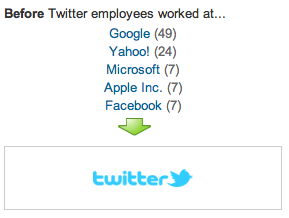
Get quick company backgrounds. On any company page, click the link on the right side that says “Check out insightful statistics…” Here you’ll see breakdowns of the job functions, years of experience, and educational backgrounds of employees, all with comparisons to industry averages. This can help you understand a company you haven’t dealt with before.
See where employees tend to come from, and leave to. On the right side of that same company statistics page, you’ll see lists of the most common companies that current employees came from, and the employers they leave for most often. You may find a trend story about who is poaching a company’s employees.
If you’ve found this useful, you can learn more and keep up with the latest changes on LinkedIn in a few ways. Follow the official blog and press center, test out beta features on LinkedIn Labs, or join the LinkedIn for Journalistsgroup for more tips and advice.
Subscriure's a:
Missatges (Atom)