Es mostren els missatges amb l'etiqueta de comentaris QR. Mostrar tots els missatges

divendres, 4 de maig del 2012

Humor? QR en la tumbaH

Del blog: SobreviviRRHHé! 


Consigue un QR de muerte!

El código QR ha venido y nadie sabe cómo ha sido.

Cada vez más utilizado, sobre todo, en publicidad. Nos venimos encontrando con una imagen como ésta de aquí a la derecha que nos sirve como puerta de acceso con nuestros smartphones a una información más ampliada del producto en cuestión.

Pero lo que ya es rizar el rizo es lo que leíamos hace unos días: Una empresa de EE UU empieza a fabricar tumbas interactivas con código QR.
Un pequeño código QR inscrito en una pieza incrustada en una tumba puede permitir a los familiares y allegados del fallecido acceder instantáneamente de forma interactiva con un recopilatorio sobre el ser querido. Randy Allen puede llevar a sus hijos al cementerio y hacer algo más que contarle historias sobre su bisabuela. Ahora puede enseñarles fotos con un simple escaneo de teléfono.
Para flipar, no creéis? 

Aquello del epitafio ya pasó a mejor vida (nunca mejor dicho), dónde esté un buen resumen audiovisual al que acceder enfocando con tu cámara al QR póstumo, que se quite lo demás. O ya puestos, un tweet a modo de entradilla y luego QR al canto.

dimarts, 27 de març del 2012

La guardia Civil en las redes sociales. web, twitter, QRs y apps...

GDT


Aplicaciones para móviles

Si navega habitualmente desde su móvil, con estas aplicaciones nos tendrá más cerca para recabar nuestro auxilio, para conocer nuestros consejos y alertas tecnológicas , para localizarnos y para denunciar todo aquello que vea y considere delictivo. Pretendemos estar "a su lado", fieles al espíritu de la Guardia Civil, intentando ser un consuelo feliz para el afligido y temido solo de los malhechores, como dice nuestro reglamento.
Su instalación se realiza desde los distintos "STORES" O "MARKETS" de cada una de las plataformas móviles.
¡Gracias por tu ayuda!


android
android
app
iphone
win_phone
qr1

GDTGuardiaCivil GDT Guardia Civil

El Grupo de Delitos Telemáticos de la Guardia Civil (GDT), fue creado en 1996, y tiene la misión de investigar los delitos informáticos.
Seguidores
 
18,795
  • fjavierguerrero
  •  
  • enfermera2pto0
  •  
  • hootsuite
  •  
  • monicamoro
  •  
  • Telmo_89
 
Siguiendo
 
24
  • rootedcon
  •  
  • nicowaisman
  •  
  • YJesus
  •  
  • MicrosoftDCU
  •  
  • twitter_es

dijous, 29 de desembre del 2011

Las nuevas tecnologías aplicadas a un congreso internacional (incluida la exposición comercial)

Twitter Dominates Social Media Buzz at Stockholm Meeting - The ASCO Post: "Twitter Dominates Social Media Buzz at Stockholm Meeting
Caroline Helwick
December 15, 2011, Volume 2, Issue 18
There was a time when clinical trial results were disseminated mainly through peer-reviewed journals that appeared in your mailbox. Computers and prompt reporting from medical conferences changed that, and same-day postings on medical websites brought “breaking news” a step closer. But the evolution has continued, and today the boom in social media—especially Twitter—has led to real-time data delivery straight from the conference hall to mobile devices anywhere in the world."

Multimedia Experience
2.18.56_tweet-box.jpgAt the 2011 European Multidisciplinary Cancer Congress (EMCC) in Stockholm, organizers for the first time took steps to encourage conference attendees to invest in the social media experience. From Twitter, video blogs, and QR codes (see page 68), to an official Congress App, new communications tools were pervasive.
For example, attendees with iPads and smartphones could navigate via the meeting App rather than tote around the program book. Every exhibitor displayed QR codes, which drove visitors to other resources on their phone or tablet devices. For Novartis-sponsored studies, QR codes allowed attendees to download PDF copies of posters.
A designated “Social Media” area near the exhibits invited attendees to log on to three social networking sites—Twitter, Facebook, and LinkedIn—and three oncology-related websites—those for the European Cancer Organisation (ECCO), the conference, and eCancerHub (www.ecancerhub.eu), a new integrated platform serving providers, scientists, patients, and policymakers across Europe.
An article in the conference newspaper extolled the value of “chatting to the neighbours” via social media, urging oncologists to ramp up their virtual connections, not only to colleagues but to their patients as well. “It is about time the professionals caught up,” the editor noted.
Indeed, Twitter hung in the air at the meeting—quite literally, as several well-placed screens aggregated the Twitter conversation throughout the day.
Over 3,000 Tweets in the Air
Niels Bramsen, Communication and Marketing Coordinator for ECCO, which oversaw the Social Media kiosk, observed that attendees were “tweeting quite a lot on iPhones, iPads, and Androids….“Twitter was a huge success, with 3,192 tweets during the Congress under the hashtag #emcc2011,” he reported. This included 382 tweets related to gastrointestinal malignancies, 320 for breast, 134 for prostate, and 122 for lung.
2.18.56_quote.jpgAmong the most active and influential Twitter users for the #EMCC2011 hashtag was well known scientist and oncology commentator Sally Church, PhD (@MaverickNY on Twitter), of Icarus Consultants, Jersey City, New Jersey. With over 6,000 followers, she “live tweeted” several sessions from the EMCC 2011 meeting and offered curated conference tweets via her Pharma Strategy Blog page (http://pharmastrategyblog.com).
Stephen Dunn, a journalist for Brandcast Health, a digital, video, and social media health-care agency, kept track of pharma activity, noting that the most mentions were for Novartis at 612, followed by Roche at 49 tweets. Mr. Dunn can be found on Twitter at @brandcasthealth.
“LinkedIn was shown considerable interest, too,” Mr. Bramsen added. “Having launched our LinkedIn groups from scratch a few weeks ago, we received 238 members in the general ECCO group and good numbers of new members in specific track groups.”
Over 2,200 attendees downloaded the ECCO App, opening 69,000 pages of Congress content, he added.
But while some attendees embraced Twitter and other forms of virtual communication, most oncologists received the Congress news the old-fashioned way: by sitting through sessions, Mr. Bramsen acknowledged.
By following the tweets, he said, “We have the impression these are mostly patient advocates (see sidebar on page 56), journalists, and industry. It seems doctors are not tweeting as much.”
Tweeting…and Much More
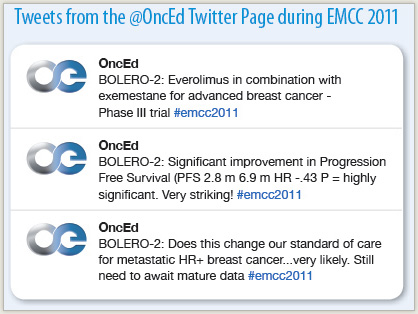
Not so for Sunil Verma, MD, a medical oncologist at Sunnybrook Regional Cancer Center in Toronto. He and his colleague Scott Berry, MD, sent more than 100 tweets from EMCC 2011 sessions to almost 350 followers via the @OncEd Twitter page (see sidebar, page 56)—and also expanding the data on their website, www.oncologyeducation.com, a multidimensional site they created “by physicians, for physicians,” Dr. Verma told The ASCO Post.
“Scott and I are interested in using Web-based technology to inform clinicians. We take the data, synthesize it, and provide our own perspective within a week of a conference. And we are getting hits from 140 countries,” he said.
“People at the meeting can’t be everywhere at once, and they want to know the results of the key trials,” he said.
EMCC 2011 was the “pilot” for what will become a full-on tweeting opportunity at the next ASCO Annual Meeting, he added, when Drs. Verma and Berry will enlist other physicians for comprehensive meeting coverage. ■
Disclosure: Mr. Bramsen and Drs. Verma and Berry reported no potential conflicts of interest.

dimarts, 6 de desembre del 2011

8 Uses For QR Codes In Healthcare Marketing | Well Done Marketing

8 Uses For QR Codes In Healthcare Marketing | Well Done Marketing: "8 USES FOR QR CODES IN HEALTHCARE MARKETING
POSTED ON JULY 5, 2011 BY KEN HONEYWELL


Eight months ago, we proposed using them on an ad, and our client had never seen one before. Today, you’re seeing them all over the place–those square Space Invader-looking boxes on ads and postcards and real estate signs and business cards. They’re called QR codes, and we imagine you’re going to be seeing a lot more of them until the next wave of technology brings something slicker to replace them.


QR stands for “quick response,” and that’s what these little boxes are all about. In essence, they’re bar codes that can be read with any mobile phone that has a QR code reader (which are free apps). Instead of requiring you to surf to a website or dial a phone number, the QR code connects you automatically. Just point your smartphone at a QR code, and you’re connected.
For example, if we wanted to show you some out-takes from an old TV session with Peyton Manning and Bill Estes, all you’d have to do is scan this code:
and you’d be enjoying all the hilarity without having to type a URL (http://www.welldonemarketing.com/2009/11/06/bill-estespeyton-manning-tvouttakes/) into your browser. Pretty slick, eh?
QR codes are free and easy to generate with any number of web-based programs. I used delivr to create the code above. It took less than a minute to copy the URL, find a generator, and create the code.
So how can you use QR codes in healthcare marketing? Let us count the ways.
1. Phone numbers. QR codes don’t have to connect with web addresses. They can also be linked with phone numbers, contact information, email addresses, and texts. A QR code can help you make an instant connection, without asking a prospective patient to remember or type a phone number.
2. Physician profiles. Want to give patients more information about your practice than can be contained in an ad? Link them to an online profile of your practice. Better yet, link them with a video of you telling them about yourself. This way, patients get to experience some of your personality and decide whether you’re the sort of doctor they’d like to see in person.

"A free first aid kit? Sign me up immediately."
3. Special promotions. Do you have a free or low-cost health screening offer? Are you hosting seminars? Offering a gift in exchange for an email address? Connect directly with your Internet-based sign-up forms with a QR code.
4. Procedure and equipment videos. Patients want to know what they’re getting into before they agree to a procedure. Don’t just show them a picture of a new piece of high-tech equipment–show them how it works with a web video linked to a QR code. It turns a static ad into a multimedia experience.
5. Maps. Your QR code can link to a Google map–so your patients don’t have to type your address into a browser to find you.
6. Health tips. Link QR codes to microsites, blogs, videos, podcasts, and other Internet-based health information. Patients won’t have to search for the timely advice they need–they can just point their smartphones at your QR code and connect immediately.
7. Post-procedure instructions. A QR code can link patients with online documents that provide instructions on how to care for themselves after a procedure, physical therapy videos, and more.
8. Physician-to-physician communications. There’s no reason to use QR codes only for patient communications: docs use smartphones, too. You can use QR codes to provide contact information for referrals, show videos of procedures, and profile your practice.
I’m sure I’ve only scratched the surface here. But you get the idea. Within a handful of years, more people will access the Internet via mobile device than with a desktop or laptop computer. Making things easier for the mobile patient should be a priority now, and will only become more important in the years ahead.
And that’s the thing to remember about QR codes. They’re not magic. They shouldn’t replace your phone number and your address in your print ads. They’re not going to attract a lot more people to your website; in fact, we haven’t seen much overall increase in web traffic since we started using them. QR codes are merely a convenience for people with smartphones; if they were going to your site, anyway, the QR code makes it easier. And when people are on the go, especially in a marketplace as competitive as health care, easier is better.


Read more: http://www.welldonemarketing.com/2011/07/05/8-uses-for-qr-codes-in-healthcare-marketing/#ixzz1fldTtsEL